The Monroe Doctrine · Latin America treated as a backyard
The Monroe Doctrine opens the way for the United States to claim the Americas as its own. In his message of 2 December 1823, James Monroe warns European powers against further colonisation and intervention on the continent. Washington assigns itself the role of judging what threatens its security. A US right to intervene is not yet proclaimed: Theodore Roosevelt will claim it in 1904.
Published: · Updated:
The patio trasero. The backyard. This is the place Washington has sought to assign to Latin America: formally independent countries whose sovereignty must stop where United States interests begin.
Who can govern, who can trade with whom, which power can enter the region. The claim is to decide on behalf of other peoples. Over time, occupations, overthrown governments, military bases and economic pressure are brought in to enforce it.
Cuba is part of this history long before the Revolution. It is discussed as territory to be bought, occupied after a war of independence, forced to accept its neighbour's right to intervene. This too is where an understanding of the bloqueo begins: with the claim that a country's choices must submit to Washington's will.
1823 · Who speaks for the Americas?
On 2 December 1823, President James Monroe addresses the United States Congress. He warns the European powers: the American continent is no longer open to new colonies. Any intervention against countries that have won their independence will be considered a hostile act towards the United States.
Washington draws the line and determines what threatens its security. The new Latin American republics are not invited to agree on it: the declaration is made by a United States president before his own Congress.
Monroe does not yet proclaim a United States right to intervene. In 1904, Theodore Roosevelt will invoke his name to claim precisely that right. The shift from opposing European colonialism to imposing United States tutelage on the continent has identifiable authors and dates.
1845 · A continent to seize
In 1845, an article supporting the annexation of Texas calls United States expansion its ‘manifest destiny’. Providence, it claims, has assigned the continent to the country's growing population. The unsigned article appears in the United States Magazine and Democratic Review. Territorial conquest is presented as a mission: anyone who resists stands in the way of a destiny already written.
Nine years later, three United States diplomats propose buying Cuba from Spain. In the Ostend Manifesto they also spell out what to do if Spain refuses: should Spanish possession of the island endanger the United States, they consider taking it by force justified.
The country has inhabitants, a society, a political will. In the document it has a price. The United States itself would decide whether to take it by force, in the name of its own security. Cubans have no voice in the proposal for the future of their land.
1898 · Peace is signed without Cuba
The Cuban independence movement had already named the danger. In his letter to Manuel Mercado of 18 May 1895, José Martí writes of his determination to use Cuban independence to prevent United States expansion through the Antilles and over ‘nuestras tierras de América’: our lands of the Americas.
On 10 December 1898, the United States and Spain sign the Treaty of Paris. Spain relinquishes sovereignty over Cuba. The first article establishes that, once the Spanish leave, the island will be occupied by the United States.
Cubans have fought for independence. At the table deciding the island's fate sit the defeated colonial power and the one about to occupy it. No Cuban delegate signs. Spain leaves; Cubans' right to govern themselves is postponed.
1901 · The Platt Amendment: independence on the occupier’s terms
The United States Congress approves the Platt Amendment on 2 March 1901. Ending the occupation depends on eight clauses being incorporated into the Cuban Constitution or an appendix. Two concern the right to intervene and land for naval bases.
Cuba's Constituent Assembly had already challenged those conditions. In its report of 26 February 1901, also signed by Juan Gualberto Gómez, the assembly's commission explains that the right to intervene and foreign bases violate the island's sovereignty: accepting them would mean Cuba could never be independent of the United States.
Washington makes these conditions the price of withdrawal. Article III begins with the Cuban government's ‘consent’. The occupied country's consent is written by the occupying country's Congress.

Article III · The right to intervene
That the government of Cuba consents that the United States may exercise the right to intervene for the preservation of Cuban independence, the maintenance of a government adequate for the protection of life, property, and individual liberty, and for discharging the obligations with respect to Cuba imposed by the treaty of Paris on the United States, now to be assumed and undertaken by the government of Cuba.
Article VII · Land for the bases
That to enable the United States to maintain the independence of Cuba, and to protect the people thereof, as well as for its own defense, the government of Cuba will sell or lease to the United States lands necessary for coaling or naval stations at certain specified points, to be agreed upon with the President of the United States.
In 1934, the treaty incorporating these clauses is repealed. The recognised United States right to intervene ends. Guantánamo remains: the new treaty keeps the base agreements in force until Washington abandons it or the two governments agree on a change. Cuba alone cannot decide to recover that territory. Tutelage is removed from the treaty; one of its consequences remains on the island.
1904 · The Roosevelt Corollary: sovereignty with conditions
In 1904, Theodore Roosevelt invokes the Monroe Doctrine to claim an international police power in the Americas. In the same speech he cites Cuba and the Platt Amendment as an example. Washington appoints itself judge of other countries' conduct and claims the right to intervene whenever it considers this necessary.
This is the logic of the patio trasero: other countries' independence remains subject to the neighbouring power's judgment. Latin America challenges it in law as well. The Montevideo Convention of 1933 affirms the principle of non-intervention; in 1936, an inter-American protocol reaffirms it. The interventions that follow show how little this limit restrained Washington.
The backyard has names.
Occupy a country. Arm those who will overthrow its government. Finance a war against those who refuse to fall into line. The methods change; the claim to decide for others remains.
Seven countries, seven documented episodes. A Latin American selection, not a total count of US interventions. Categories may overlap. Armed interventions include US-backed forces, not only US troops.
7 countries shown
The same claim, across the century
Each point marks the opening year of the selected episode, not the full duration of the intervention. Select a country to open its account.
Open a country: read what the United States did and the document that records it.
1915–1934HaitiA country under occupation
In 1915 US marines land in Haiti. Washington imposes control over public finances and backs the installation of a president favorable to the United States. The troops remain until 1934: nineteen years of Haitian sovereignty subordinated to occupation.
1954GuatemalaAn elected president overthrown
Guatemala, 1954. The CIA organises the operation that overthrows elected president Jacobo Árbenz. Five years before the Cuban Revolution.
1961CubaThe CIA-organized invasion
On 17 April 1961 a brigade of Cuban exiles trained by the CIA lands at the Bay of Pigs. Kennedy has authorized the plan: overthrow Cuba’s government and replace it with one friendly to Washington. The invasion is defeated.
1965Dominican RepublicThe marines in Santo Domingo
Dominican Republic, 1965. The United States lands troops. President Johnson states the goal: preventing another communist state in the hemisphere.
1970–1973ChilePreventing Allende from governing
Chile, 1970–1973. The CIA seeks to instigate a coup to prevent Allende from taking office in 1970; covert support for the opposition continues afterwards. Its report to Congress documents this.
From 1981 · judgment 1986NicaraguaThe Contra war
Nicaragua, the eighties. The United States arms, trains and funds the contras. In 1986, the International Court of Justice rules that this support violates the obligation of non-intervention.
The year 1986 marks the Court’s judgment, not the end of the Contra war.
1989PanamaThe invasion of Panama
Panama, 1989. The United States invades the country. The UN General Assembly deplores the intervention as a violation of international law.
Intervention, inside the frame
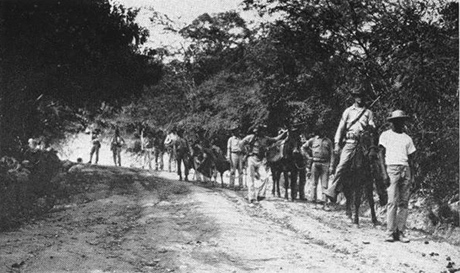

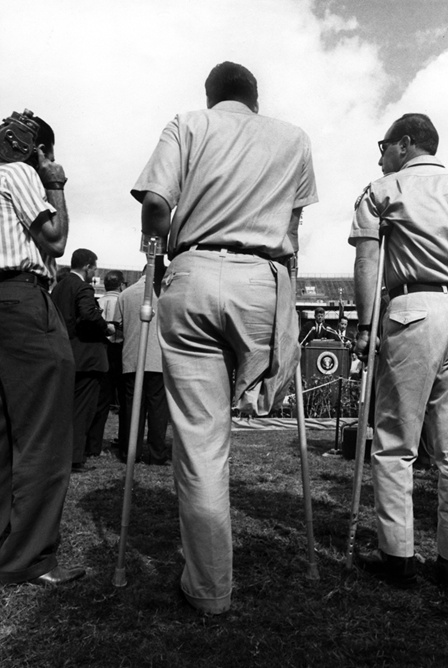
Guatemala comes before the Cuban Revolution. The date alone disproves the idea that this policy began as a response to Castro. And in Guatemala and Chile, elected presidents are targeted: even the ballot can become an obstacle when Washington dislikes the result.
1959–1961 · Cuba must have a government Washington approves of
After the Cuban Revolution of 1959, Washington prepares to replace Fidel Castro's government. The covert action programme approved by Eisenhower in March 1960 sets two goals: a government more acceptable to the United States, and no appearance of United States intervention.
Choosing Cuba's government is treated as a United States prerogative. The plan must deliver the result and conceal the hand imposing it. This is backyard policy written into an operational programme.
Bay of Pigs, 1961 · At Playa Girón, Cuba repels the invasion
On 17 April 1961, Brigade 2506, a force of Cuban exiles trained and supported by the CIA, lands at Playa Larga and Playa Girón. The operation prepared under Eisenhower is carried out under Kennedy. Cuban forces defeat it by 19 April.
The government Washington wanted to replace remains in power. Cuba has fought off an attempt to decide from abroad who should govern it.
Economic pressure was already part of the plan. On 6 April 1960, a year before the landings, Lester D. Mallory proposed reducing Cuba's resources to bring about hunger, desperation and the overthrow of the government. An internal Department of State memorandum sets out the population's suffering as a means to a political end.
Here the patio trasero enters everyday life: to change a country's government, the proposal is to make life unbearable for its inhabitants. The document bears a date and a signature. This choice is where the story of the bloqueo begins.